
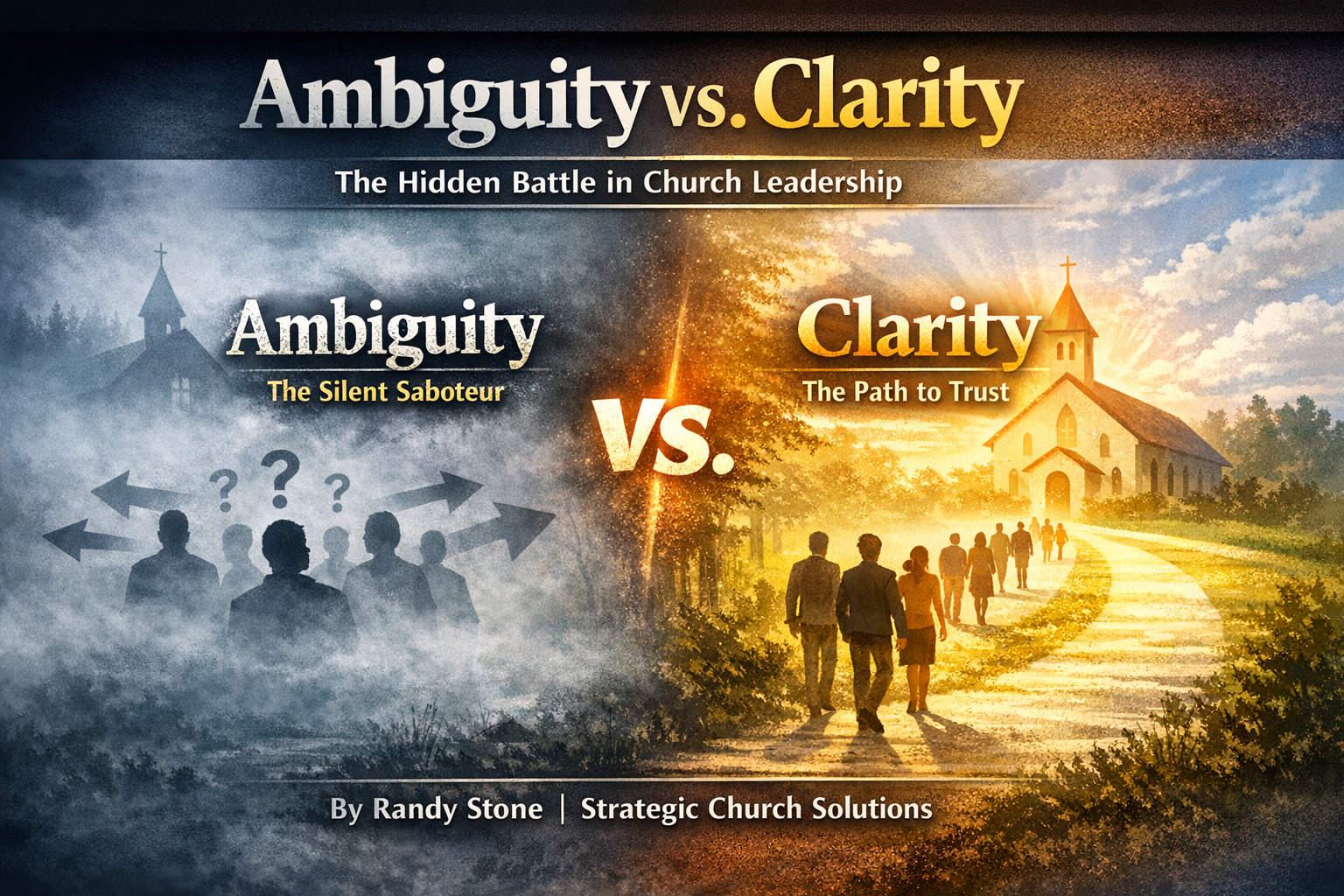
Ambiguity; The Silent Saboteur
Randy Stone • April 8, 2026
Ambiguity Always Breeds Animosity

Ambiguity: The Silent Saboteur
By Randy Stone, Lead Consultant and Coach, Strategic Church Solutions
Church conflict rarely begins with bad people—it usually begins with unclear expectations.
When the vision, values, or policies of a church are fuzzy, leaders and members are left to fill in the blanks with their own assumptions. Over time, those assumptions harden into ambivalence (“I don’t really care anymore”) or animosity (“I don’t like how this is being handled”).
Ambiguity is not just an organizational weakness—it’s a spiritual hazard.
1. The Hidden Cost of Unclear Direction
When vision is vague, people drift.
When policy is inconsistent, people divide.
Leaders often underestimate how much clarity sustains unity. A team can endure disagreement if the mission is clear, but it will crumble when the mission is confusing. Without clear direction, even the most faithful members begin to wonder: What are we really doing here—and why?
“A confused team will eventually become a conflicted team.”
Ambiguity drains morale, multiplies misunderstanding, and fosters cynicism. It replaces shared conviction with personal interpretation—and personal interpretation is the breeding ground for conflict.
2. Vision Ambiguity: The Fog That Frustrates
A church without a clearly articulated and consistently repeated vision is like a ship without a compass. Ministries compete for attention. Leaders operate in silos. Volunteers wonder if their service even matters.
The result isn’t rebellion—it’s fatigue. People stop pushing forward because they can’t see where “forward” is.
Clarity of vision provides emotional energy and alignment. When everyone knows the “why,” the “how” becomes easier to navigate. A clear vision turns confusion into cooperation.
“When vision fades, enthusiasm follows.”
If your church can’t answer in one sentence what its primary mission is, your members are likely answering it in twenty different ways.
3. Policy Ambiguity: The Gap That Grows
While vision sets direction, policy defines boundaries. When policies are inconsistent or unclear, frustration is inevitable.
Why was one person removed from leadership while another was not? Why does one ministry receive funding while another is cut? Why are some exceptions made and others denied?
When policy is unpredictable, people begin to suspect favoritism or unfairness. Even the most loyal leaders lose trust when decisions appear arbitrary.
Consistency communicates integrity. Clear policy protects both leaders and followers from the perception of bias.
“If it feels unfair, it soon becomes personal.”
4. The Leadership Mandate: Clarify or Confuse
Ambiguity is a leadership failure, not a personality flaw.
In the absence of clarity, people will create their own narratives—and once those narratives take root, it’s hard to regain trust.
Every pastor and church leader must regularly ask:
• Does our staff understand our mission in the same way?
• Are our key policies written, accessible, and applied consistently?
• Do we correct confusion quickly or allow it to linger?
Clarity is not control—it’s compassion. It shows respect for the people we lead by giving them the information they need to serve confidently and consistently.
“Clarity is kindness. Confusion is cruelty.”
5. Building a Culture of Clarity
Churches that thrive in unity build systems that eliminate guesswork. Clarity becomes part of the culture. It shapes how meetings are run, how volunteers are trained, and how decisions are communicated.
To cultivate clarity in your ministry:
• State the Vision Often. Repetition builds alignment.
• Write Down Policies. If it’s not written, it’s not remembered.
• Apply Consistently. Exceptions invite confusion.
• Communicate Transparently. Silence is never neutral—it breeds suspicion.
• Review Regularly. Vision and policy drift happens slowly; clarity requires maintenance.
When clarity is consistent, unity becomes natural.
6. Conclusion: Leading with Definition
Ambiguity always breeds ambivalence or animosity—but clarity breeds confidence.
Leaders who define the vision and apply policies consistently create trust, energy, and alignment.
In the Kingdom, clarity isn’t about control; it’s about stewardship. We owe it to those who serve with us to ensure they understand where we’re going and why.
Where there is clarity, there is confidence. Where there is confusion, there is conflict.
Healthy churches choose clarity.
About Strategic Church Solutions
Strategic Church Solutions helps churches develop healthy systems, empowered teams, and mission-driven leaders.
Learn more at www.strategicchurchsolutions.com

Generational Gap or Cultural Collision: Understanding Young Adults as a Culture Group

Every healthy church group needs a Connection Catalyst—someone who notices newcomers, follows up with the missing, and helps people move from attending to belonging.

Close-knit small groups can become closed-off when they stop welcoming new people. Learn how churches can protect warmth, openness, and mission in group life.

Close-knit groups are healthy until they become closed-off. Learn how churches can keep small groups open, mission-minded, and welcoming to new people.

Transactional ministry may attract people, but relational ministry helps churches make lasting disciples.

See how clear vision, values, and expectations help church leaders build confidence, unify teams, and create a culture of cooperation and collaboration.

Explore the danger of “asymptomatic Christianity” and why churches must move beyond belief alone to cultivate visible, obedient, life-changing faith in everyday living.

Learn why wise, timely, Spirit-led decisions are essential for healthy ministry leadership. Discover how decisions shape direction, strengthen organizational health, and move churches toward greater mission impact.

Many believers get stuck in “arrested development” when hurts, habits, and hang-ups derail growth. Discover a biblical path to healing, renewal, and maturity.
